


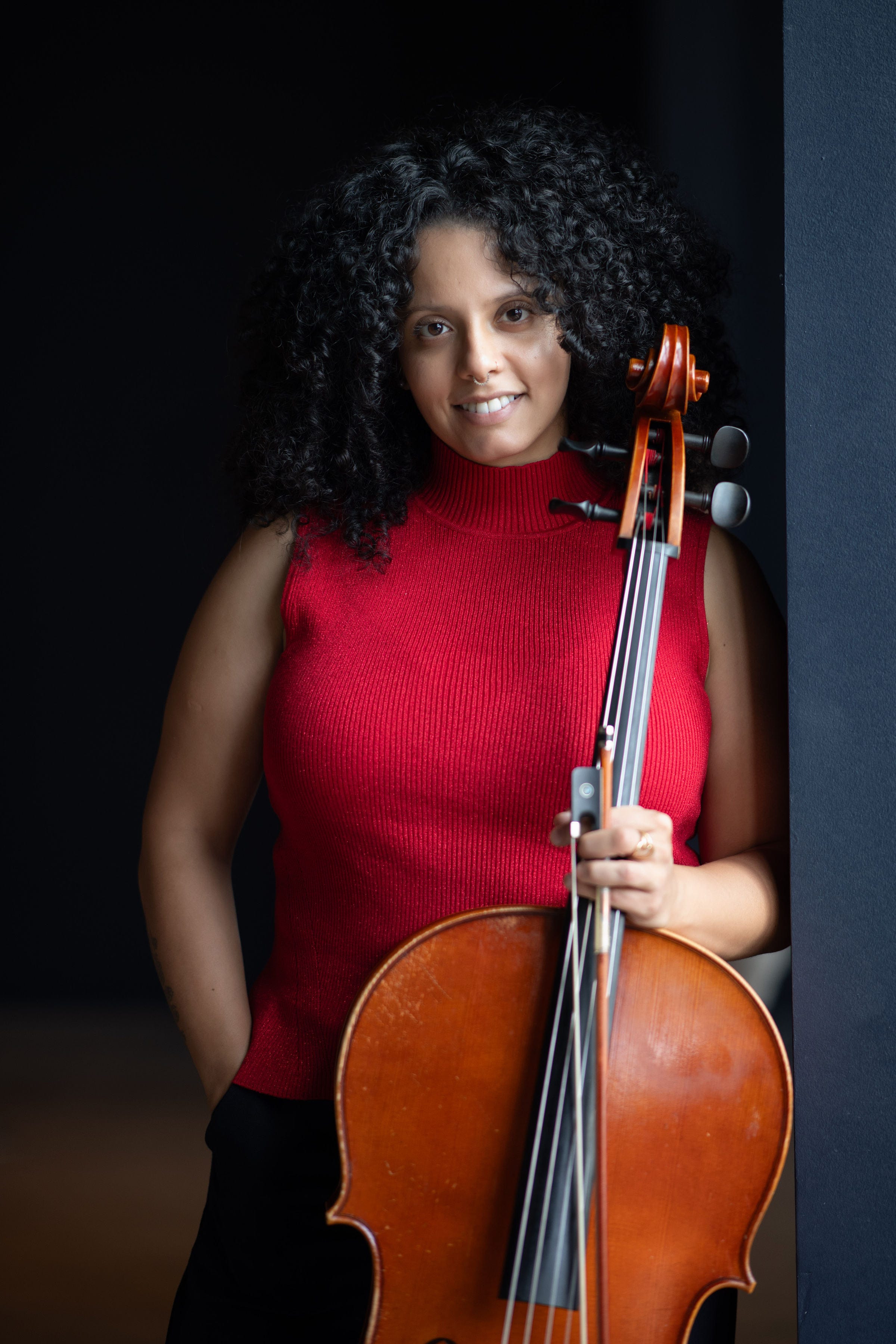
Brazilian cellist Roberta dos Santos grew up in the peripheries of Taboão da Serra, in the metro area of São Paulo, first playing organ in her church before discovering the cello at the age of 17 through a free nonprofit program. That opportunity launched her into conservatory training, two master’s degrees, and now a DMA in cello performance in Memphis, where she studies with Kimberly Patterson. Roberta is active as a performer, teaching artist, and researcher of Brazilian music, committed to expanding access to high‑level musical training for young people from underserved communities.
“One of my students always says, ‘But I’m so bad at it.’ And I tell her, you didn’t even try yet. Teaching is my way of talking to my younger self. There are so many ways you can hurt someone for life as a music teacher. You’re not just teaching technique—you’re teaching confidence.”
What is your main instrument, and how did you choose it?
My main instrument is cello, but my first instrument was organ in my church in Brazil. In my church, women only played organ—men played all the other instruments—so that’s where I started around age 11, just playing hymns by ear with one finger next to my mom.
I discovered the cello at 17 in a nonprofit music program in my hometown. One day I saw a student walking by with this huge instrument and said, “I want that big one.” My mom was upset because we had no money to buy a cello, but the nonprofit offered free lessons and let me borrow an instrument. That moment completely changed the direction of my life.
When did you realize music was more than just a hobby?
As a teenager, my life was complicated. My parents divorced when I was 12, and I had to take on responsibilities that were too heavy for my age, especially helping care for my younger sister. I was always searching for something—crocheting, painting, any hobby that could help me express what I was feeling.
When I started cello at 17, it became more than a hobby. It was a way to escape and process what I couldn’t put into words. I would travel hours across São Paulo by bus just to get to my lesson. That kind of commitment made it clear that this wasn’t just something to pass the time. It was becoming my path.
What kind of sacrifices did you make to study music seriously?
The nonprofit didn’t have a cello teacher at first, or even a cello for me. The director basically said, “If you trust me, keep coming. I’ll find you a teacher and an instrument.” So I kept showing up.
When I finally started lessons, I had to take public transportation for about two hours each way, with a big cello in a soft case on packed, bumpy buses. It added up to five hours of commuting for one lesson.
Later, in college in São Paulo, my classes started around 7:30 a.m., and I often stayed at school practicing and playing in orchestra until 10 or 10:30 p.m. I eventually moved in with six other women, all musicians, just to be closer to the university so I could survive the schedule.
It sounds extreme, but if you don’t have money or connections, your commitment and consistency become your main currency.
Did people ever make you feel like you didn’t belong in music?
Absolutely. I started cello “late” compared to people who began at 5 or 6. When I got to college, I was surrounded by musicians my age who had been training for many more years. I often felt like I didn’t deserve to be there.
On top of that, I still remember hurtful comments from earlier teachers and adults—things that made me doubt if I was good enough or “too old” to catch up. Those words stay with you.
Now, as a teacher, I use those memories as a guide for what not to do. I don’t want my students to hear the kind of comments that almost made me quit. I made it, not because I was special, but because I kept showing up. That’s the message I want them to receive.
How did your church background help you—and hurt you?
Church is a huge part of my musical story. I learned to play by ear, to sing, to understand harmony without knowing the formal names for anything. That made theory and ear training in college much easier for me.
But there was pain too. In my church, women were expected to play only organ, not instruments like cello. Some people told me I shouldn’t use music to make money, or that I should stay in my lane and not pursue a professional career.
I disagree with that completely. Those attitudes hurt, and they made me question myself. But I can’t erase that experience—it shaped who I am. It also taught me the importance of not limiting other people because of tradition or fear. 𝄂
Next time, we’ll look to the future with Roberta dos Santos to discuss her plans, favorite music, and her best advice for musicians like you. See you next time!
What an inspiring cellist — how thoughtfulness and consistency are the bedrock of mature musicianship. "It sounds extreme, but if you don’t have money or connections, your commitment and consistency become your main currency." So true, and so important to put that out there.