


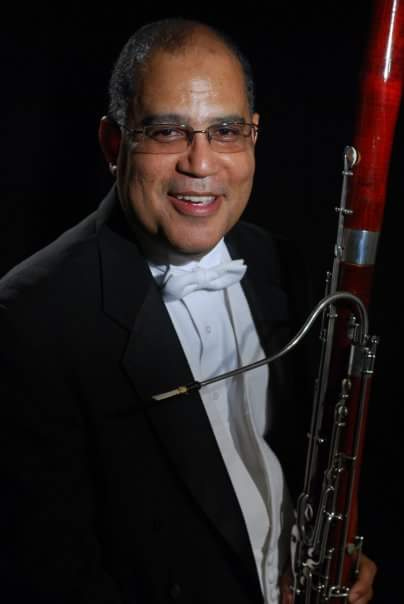
"You're always a product of your environment, and you know, sometimes, if the environment is not right, you got to figure out how to make it right."
– Michael Scott
1. What is your main instrument?
My main job is as a bassoonist. I am the second bassoonist in the Memphis Symphony Orchestra, and I have had that chair since 1976. Bassoon is home base for me in the orchestra, but I am a multi-instrumentalist, so I also play saxophone on the pops series and other programs when they need it.
2. When did you start playing?
I started on alto saxophone in seventh grade at Corey Junior High and played sax through ninth grade. When I got to Hamilton High School, they handed me a bassoon, which I had never even seen before. My band director, Thomas Doggett, joked that I was so tall and skinny I looked like one. At first it was pretty hit and miss. The only other person I knew who had played bassoon was a friend a year ahead of me, and we were just figuring it out together. Things changed when another friend, who was in the Memphis Youth Symphony, invited me to a rehearsal. He introduced me to Vincent DeFrank, and even though I was almost embarrassed to admit I played bassoon, DeFrank told me to come join them. I came back the next Sunday, sat between two experienced players, and they basically adopted me and showed me what I needed to know.
3. What was high school like for you musically?
Hamilton had everything: a big marching band with about 150 people, plus concert band and jazz band. In concert band I was mostly on bassoon, and in jazz band and marching band I played alto sax. You do not march with a bassoon. I started taking private bassoon lessons in 11th grade; before that it was just what we did in band class. Around that time I went to the Midwestern Music Camp at the University of Kansas for six weeks. There were kids from all over, maybe 85 saxophonists and only about 12 bassoonists. That is when I started thinking about supply and demand. If I wanted to work, bassoon might be the smarter vehicle. The next year I went to a similar camp at the University of Iowa. I was last chair bassoon in Kansas but first chair alto there, so even then I was weighing those two paths.
4. Did you study music in college?
Yes. I went to what was then Memphis State, now the University of Memphis, and majored in music education. My teachers told me that was the best degree if you wanted options, because you could always teach. My parents were schoolteachers, and I spent my summers taking general education classes. That let me load up on music during the fall and spring, 18 to 22 hours of music while most people took 15 mixed hours. I played in four or five ensembles every semester. My teachers never told me to choose just one instrument. They knew I played saxophone and bassoon. I played alto sax in jazz ensemble, bassoon in the wind ensemble and concert band, and eventually in the orchestra once some upperclassmen graduated.
5. When did you start doubling seriously?
That really took off at Memphis State. The jazz band put us in a spot where we needed to learn clarinet, and later I picked up flute. My first real doubling gig was a summer production of “Purlie Victorious” the university did with the opera department. I was playing alto sax, clarinet, and flute, and I had only been on clarinet and flute for about a semester when the music director asked if I could play them. I said yes, and the parts were simple enough that I got through it. That gig paid about $250 for two weeks, my first “doubler’s check.” The success of “Purlie” led to more shows with the theater department such as “Guys and Dolls” and “South Pacific”, and many of those required doubling. In some ways, my career has looked the same since I was 18 or 19, moving between instruments and between classical, jazz, and theater work.
6. How did you move from school into a professional career?
I have been a professional musician for over 50 years now. At Memphis State, I was surrounded by people like James Williams and Donald (Don) Brown, musicians I had known since we were teenagers who went on to work professionally, and that community mattered. I finished my bachelor’s in four years with 176 credit hours. The degree only required 132. If I had taken a foreign language, I could have had a double major in performance and music education. I initially had an assistantship lined up at the University of Illinois, but it disappeared for political reasons. Around then, the Memphis State jazz band played the Wichita Jazz Festival, and I got a soloist award. The jazz band from Western Illinois University heard me and offered me a scholarship, which is how I ended up in graduate school in Macomb, Illinois. There was not much to do there except play and go to school. I taught a jazz band, played in ensembles, and studied bassoon with Robert Kipper, who told me I would probably be a good fit as a community college teacher and prepared me for that.
7. How long have you been earning your living in music, and what does that include?
By the time I finished graduate school and came back to Memphis, music was already my path. I tried to interview with the Memphis school system, but the supervisor missed the appointment. A couple of days later, some of my old professors called about an opening at Shelby State Community College. My mother said, “You need to come home,” so I did. I went through the interview process there, and the president, Jess Parrish, remembered me from Memphis State because the jazz band used to play for administrative events. I was hired at Shelby State on a Tuesday and auditioned for the Memphis Symphony that Thursday, the same week in August 1976. I stayed at the college for 41 years and eight months, teaching everyone from fresh out of high school students to grandparents coming back for retraining, and all that time I was playing with the symphony. Along the way I built an online Music Appreciation course, did some consulting with McGraw Hill, and figured out how to get community college students into symphony concerts. Once classical music bit me, it stayed with me, and between performing and teaching, that is how I have made my living for decades. 𝄂
Next issue, we will dig into how Michael approaches doubling, the styles he plays across symphonic, jazz, and theater work, and what he tells young musicians who want to make a career in music.
Getting the Gig exists to surface exactly this kind of detail—so high school musicians (and their parents) can see what real, workable music lives actually look like.