


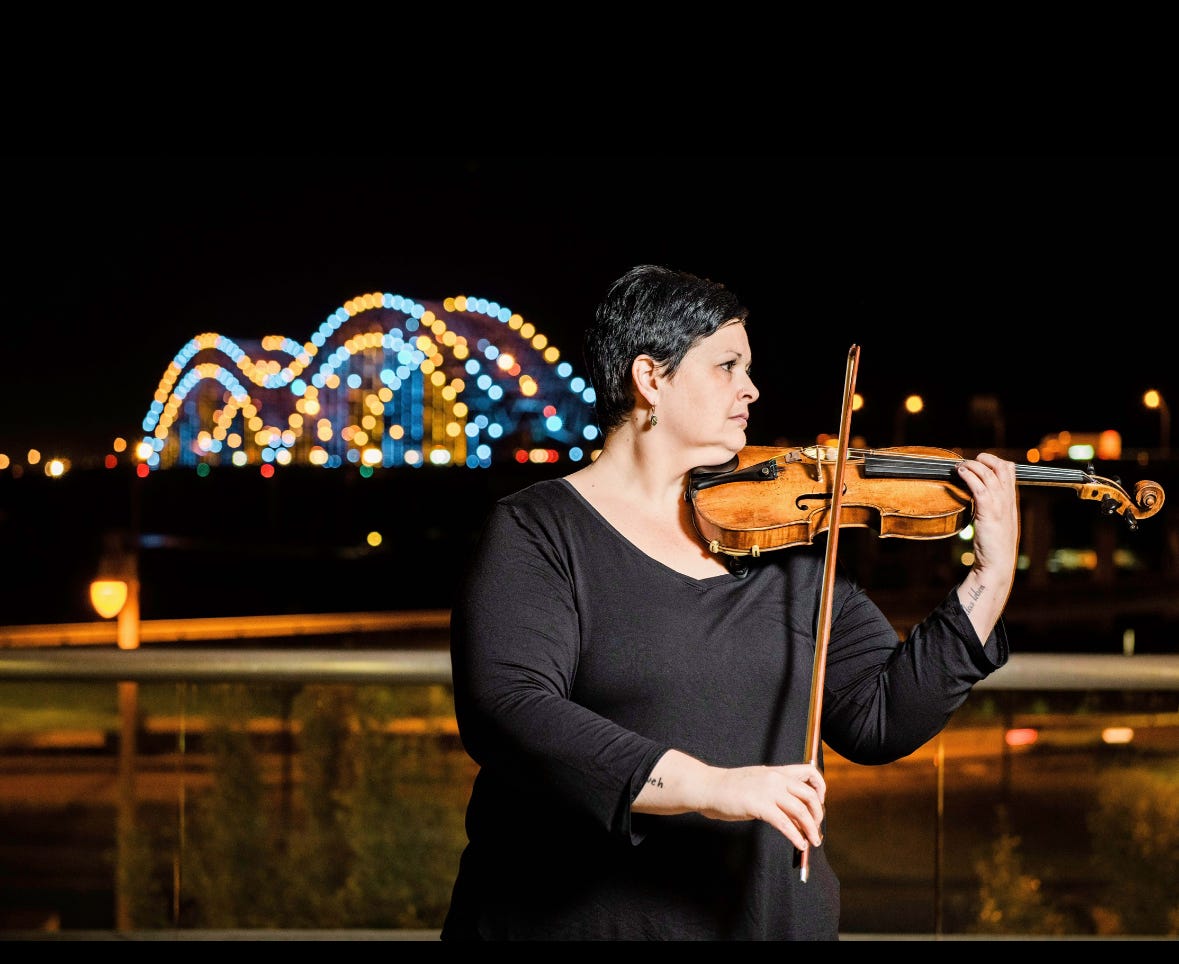
1. What does a concertmaster actually do?
About one to two months before the orchestra gets the music, I get a copy from our librarian and play through every note, decide where the down bows and up bows go. Sometimes I check what orchestras like Vienna or Berlin did. And I like to think about the style of the piece and the personalities in our group.
“If I do that, this person is going to pounce on that down bow, so I’m going to change that so we don’t get a big accent.”
Sometimes it takes four or five hours, sometimes much less. When I am done, the other principal players use my part so their bowings match or coordinate with mine.
2. How do you work with the rest of the strings?
My bowings go through violins, violas, cellos, and basses, but cellos and basses are in their own world physically and technically. What is hard for violins can be easy for them, and the reverse.
So I sometimes write in their parts:
“I’m not sure if this works for you or not, but this is what we’ll do. Do what you need to do.”
We want a unified look and feel, but each instrument group has some freedom to do what makes sense.
3. How do you handle tension between conductors and musicians?
A big part of my job is to stand in the middle and keep things calm.
“I will put myself in front of someone. I can take it, I’m strong, I’ll stay usually calm. Let me be the one that defuses.”
Our music director, Bob Moody, is very kind and genuine. He trusts me and listens to my opinion. Ultimately, he is the boss, but if we disagree, we work together to find a solution. We also have an orchestra committee of elected players. They help when someone feels unsafe or something seems unfair. For big decisions, the committee and I should be informed, not surprised.
4. What do you wish you could tell your high‑school self?
Where you are right now, you are actually enough.
In high school I struggled with confidence and shyness. Looking back, I would tell myself:
You are not as far behind as you think
Trust the process
What you are doing is okay
For students, I would say the same thing. Keep working, but remember you are enough right now, even while you are still learning.
5. What are some favorite teaching and side‑by‑side moments?
In side-by-side concerts with the Youth Symphony, each professional sits with a student. I have sat with the same student for two years.
This year he had some tough solos and told me he was nervous, but I reminded him he had played all those notes before and could do it.
During Scheherazade, he was playing a big solo beautifully, but his violin was falling apart. I said, “Take mine, play mine, it’s easy,” and we swapped instruments. His friends were thrilled, and I think it boosted his confidence.
Earlier in my own career in St. Louis, someone once loaned me their Amati violin for a month so I could play the Barber Concerto. It was worth a fortune, but the message was that they believed in me. I try to pass that same belief on to my students.
6. What was it like to play in the Musikverein in Vienna?
I spend my summers at the AIMS Festival (American Institute of Musical Studies) in Graz, Austria, an opera festival that needs an orchestra. This is my 24th summer there.
Last summer, we played in the Musikverein in Vienna, home of the Vienna Philharmonic.
“I don’t know that I’ve ever been awestruck like I have in that concert hall. It was almost like somebody was taking over your instrument and doing it for you.”
It was special because the acoustics feel otherworldly, I mean, even the more jaded players were speechless. I kept thinking of Brahms, Bernstein, and all the greats who played there. I keep photos from that concert in my violin cases. I can almost hear that hall again in my memory. 𝄂
Getting the Gig exists to surface exactly this kind of detail—so high school musicians (and their parents) can see what real, workable music lives actually look like.