


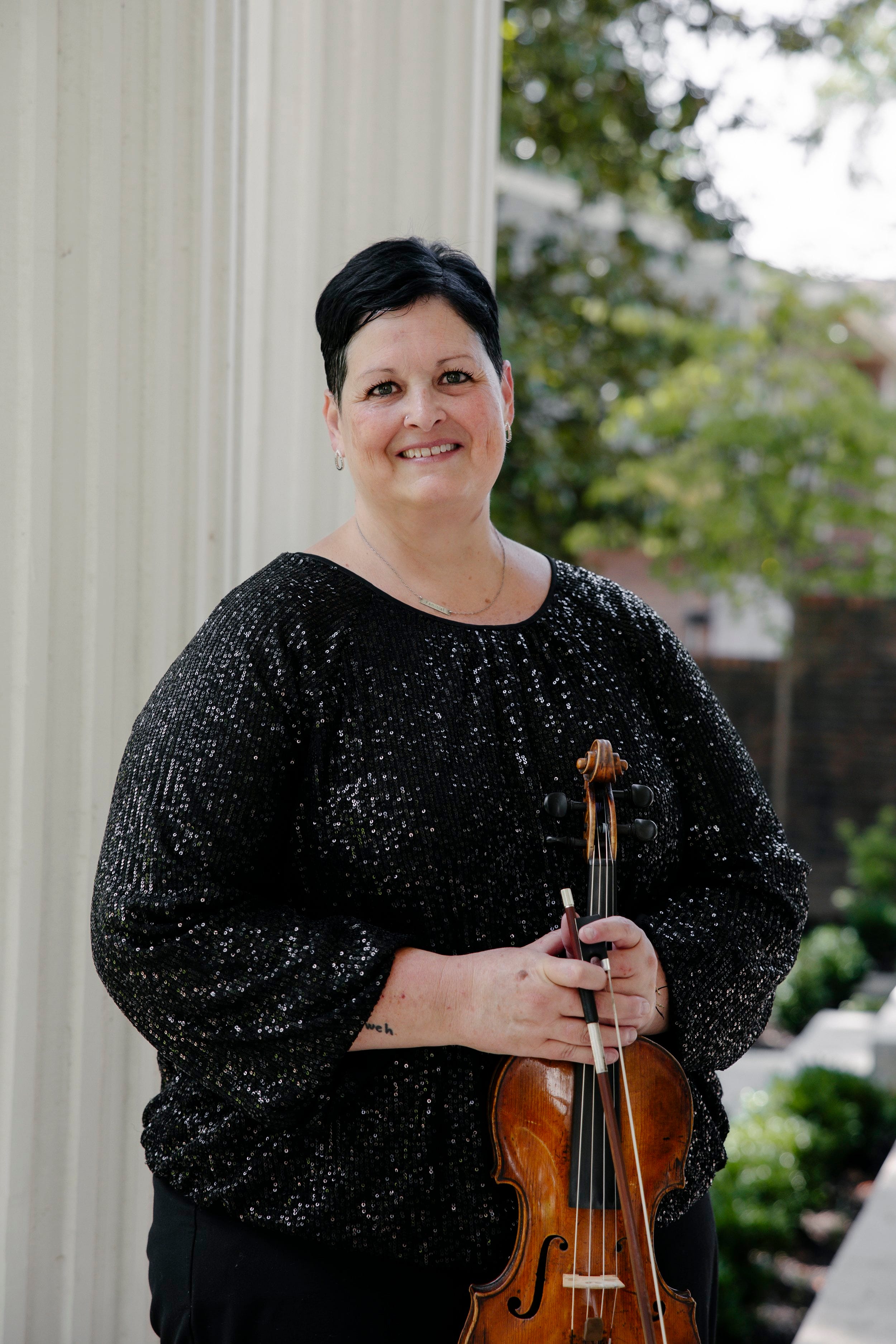
1. Where did you grow up, and how did you first get into the violin?
I grew up in Bethalto, Illinois, near St. Louis. Lots of cornfields, but you can see the Arch in the distance.
I started violin at four years old, and it was my idea. My parents were young “hippie” parents with a big vinyl collection, so we stayed home, picked records, and listened together. We heard everything from Shostakovich to Hair to Ravi Shankar to Perlman playing Bach. I just fell in love with the violin and asked for lessons.
2. Did you learn through school, or somewhere else?
I didn’t have a school orchestra at all. Everything was through the Suzuki program at Southern Illinois University Edwardsville.
My teacher was actually the first American to go to Japan to study with Dr. Suzuki and bring the method back. At the time it just felt normal. Only later did I realize how lucky we were.
3. What did Suzuki look like for you as a little kid?
Suzuki involved my parents a lot. My mom took a semester-long parent class to learn how to help me practice and stay motivated.
I did not get a real violin right away. I started with a Kraft macaroni box and a ruler as my “violin” to learn posture and how to hold it. Violin posture is very unnatural, so they build your muscles and coordination first, then add the real instrument.
4. What was your weekly routine like with violin?
From early childhood until I left for college, it was:
One private lesson each week
Group classes every Saturday
Saturday usually included:
Technique work
A recital
Music reading
That was my real musical world. My high school band, as my mom joked, was “clarinet and cowbell.” So it felt like I had a double life. Regular school on one side, serious music at the university on the other.
5. What kind of student were you, and how did violin help?
I was extremely shy and timid. My mom says I barely talked to my violin teacher for about ten years. If someone said, “Hi, how are you” I might cry.
I also had learning differences, so school was tough and my confidence got lower and lower. I mostly did just enough to get through.
Violin was completely different.
“Violin was always my safe space. I don’t have to talk, I can tell you with my playing.”
Honestly, it kept me in school. Without violin, I might have dropped out.
6. When did you know you wanted to do this long term?
Very early. By second or third grade, I knew I wanted to do music.
At first, I wanted to be a violin teacher. That shows how positive my teachers were. Like many kids, I had a short “I want to be a soloist” phase, but I mostly thought: quartets, symphony, anything with a violin in my hands, I want to do.
7. How did your family react to you choosing music?
My parents were totally supportive. They have been together since they were 17 and 19, and they grew up with us.
There was never “You will not make money” or “Do something else.” It was always:
“You can do what you want. Let’s talk about it and make sure it is right.”
So when I said I wanted to study music in college, they backed me up.
8. Did college go smoothly, or did you hit some bumps?
I definitely hit bumps. I started at Ithaca College. I liked the school, but my violin teacher was going through a very hard time and it came out as bullying her students.
I was working very hard, but my lessons were miserable. That was the only time I thought about quitting violin. I even told my mom on winter break, in the grocery store, “I don’t think I can go back.”
I finished the year, then transferred to Peabody Conservatory in Baltimore. That changed everything. I went from “I never want to play again” to being excited and inspired. We went to the Baltimore Symphony all the time, and I realized I really wanted to play in an orchestra.
I also learned that hard seasons are normal, and you can set boundaries, move on, and still love the instrument. 𝄂
Next issue, Barrie will explore the different roles of being a concertmaster, and some helpful advice she gives to her students.
Getting the Gig exists to surface exactly this kind of detail—so high school musicians (and their parents) can see what real, workable music lives actually look like.